
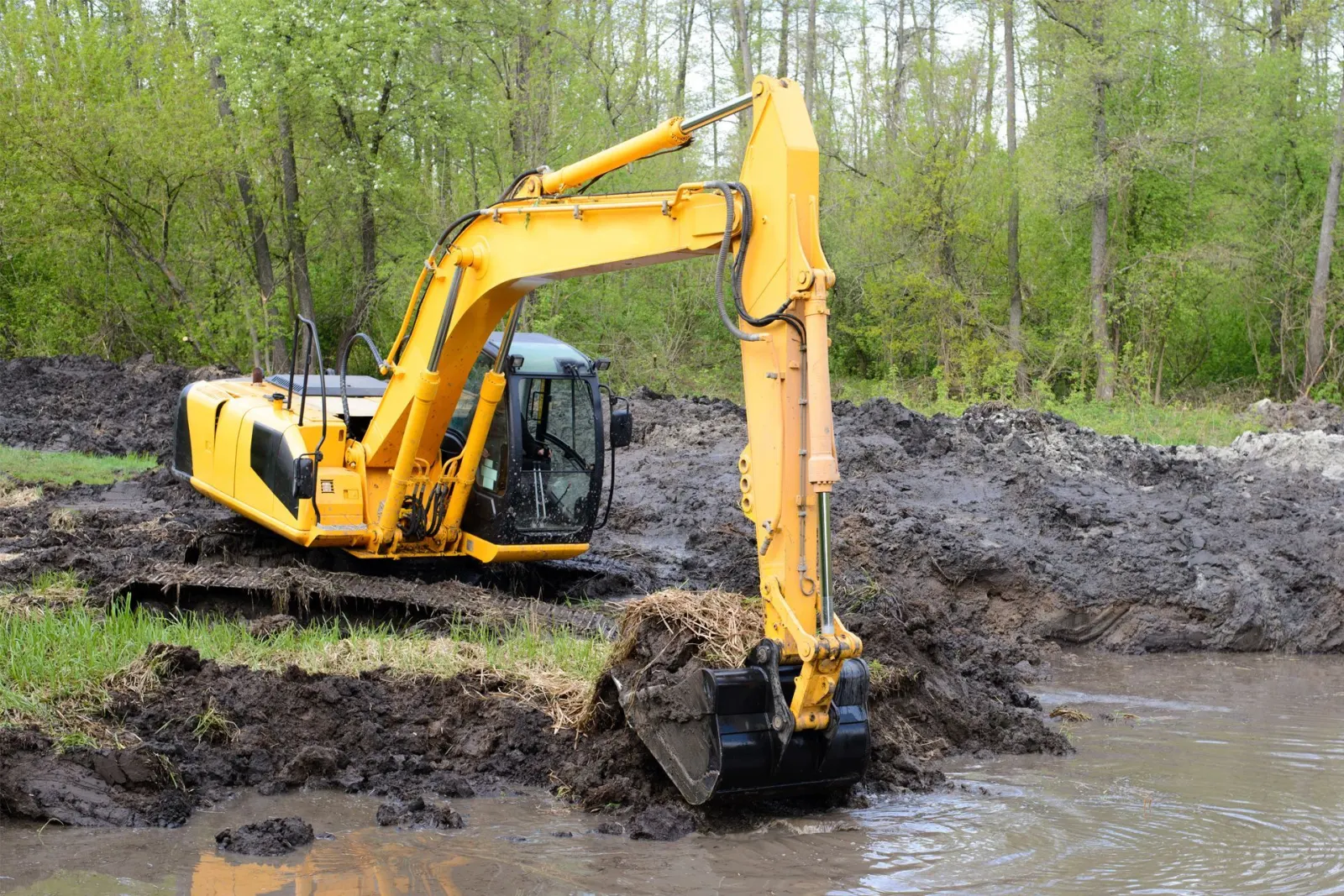
How Much Does It Cost to Dig a Pond in Florida?
Most private ponds in Florida land in the low five figures. National cost guides put a farm pond at $5,000 to $20,000 on average. One guide gives a tighter range of $3,750 to $13,000. Priced by the acre, ponds dug for farm or fishing use run about $2,000 to $25,000 per acre.
That spread is wide because a pond is a dirt job. Size and depth set how many yards come out. Soil and access set how fast those yards move.
We handle pond construction on private land around Monticello, and every site prices on its own ground. These are market numbers, not our price list.
What Does a Pond Cost by Size?
National cost guides break pond pricing out by surface size. The table below is their published range, not ours.
| Pond size | Published range |
|---|---|
| Up to 5,000 square feet | $3,000 to $15,000 |
| Up to a half acre | $4,000 to $25,000 |
| One acre | $7,000 to $25,000 |
| 10 acres | $20,000 to $50,000 |
| 20 acres | $40,000 to $100,000 or more |
Source: HomeAdvisor pond cost guide, updated 2026.
Two things stand out in that table. The price per acre drops as the pond gets bigger. Another guide puts ponds and lakes of 10 acres and up at $1,400 to $4,800 per acre. A machine already sitting in the dirt is cheaper by the yard than one that mobilizes for a small hole.
The second is how far the top of each range runs. A one acre pond can be $7,000 or it can be $25,000. That gap is the ground, not the acre.
How Do Contractors Price Pond Digging?
Most pond work gets priced one of three ways. By the cubic yard of dirt moved, by the machine hour, or by the acre of finished water. Bigger jobs usually go by the yard or the acre.
National cost guides put excavation on a larger pond at $1.50 to $3.50 per cubic yard. On machine time, the same guides list a compact skid steer or backhoe near $100 an hour with an operator. A bigger excavator runs roughly half again more per hour.
Watch the units when you compare quotes. Guides list small garden pond digging at $60 to $200 per cubic yard, which is a different kind of work. A backyard water feature and a farm pond are not priced off the same sheet.
What Drives the Price of a Pond Dig?
Depth moves the number as hard as width does. UF/IFAS extension says Florida ponds should be at least 6 to 8 feet deep. Going from 4 feet to 8 feet on the same footprint about doubles the dirt.
Soil is next. Cost guides note that rocky or hard clay ground adds to an excavation bill. Sandy ground digs fast but may not hold what you put in it.
Then there is the spoil. Every yard that comes out has to go somewhere. Spread on low ground across the property, it is cheap.
Hauled off, national guides put bulk dirt hauling at $8 to $25 per cubic yard. That one choice can swing a pond budget by thousands. Spreading spoil is part of the excavation work we do on rural land.
Site prep and access finish the list. Brush and trees on the pond footprint come off before the dig, and land clearing carries its own price. One national guide lists Florida’s state average to clear land at $2,550. A pond in a back field may also need a way in for the machines.
Does North Florida Soil Change the Price?
Two kinds of ground sit inside our area. North of Monticello toward Thomasville is the Red Hills, rolling clay hill country. UF/IFAS extension says soils high in clay are good for the pond bottom. Those sites usually dig and hold without extra help.
South and east the land flattens into sandy pine flatwoods. UF/IFAS says soils high in sand or gravel may seep unless the water table is naturally high. The same publication puts Florida seepage at 1 to 4 feet a year. Summer evaporation runs near 6 inches a month.
That is where a sandy site gets expensive. Sealing the bottom is separate work with its own price. Cost guides put bentonite clay sealing at $1.05 to $2.50 per square foot. Ponds already holding water on nearby land are the cheapest clue you have about your own dirt.
What Does It Cost to Clean Out an Old Pond?
An old pond is rarely the pond that got dug. Silt washes in with every hard rain and the shallow end fills with muck. National cost guides put pond dredging at about $1.70 to $2.50 per square foot.
Two things set that price. How much material comes out, and where it goes to dry or unload. Wet muck has to dry before it can be spread, which adds days to the job.
Some landowners pair a cleanout with opening up the ditches that feed the pond. Silt has to come from somewhere, and a washing ditch bank keeps sending it. Fixing both at once puts one set of machines on the property instead of two.
Do Permits and Water Rules Add Cost?
Sometimes, and it depends on the site. National cost guides put permit fees around $150 to $500 where one is needed. That is small next to the dirt, but a review can add time to the schedule.
Florida handles this work through environmental resource permitting. The Suwannee River Water Management District says an ERP is required for development or construction activities. The stated purpose is reducing flooding and protecting water quality and wetlands.
That district says its rules reach agricultural and residential work. Exemptions exist in the state rules, and exempt work cannot have wetland impacts.
Jefferson County is split between two water management districts. The Northwest Florida district and the Suwannee River district each cover part of it. Your county office and your district are the ones to ask. Before any digging starts, buried lines get marked through Sunshine 811, Florida’s free one call service.
Where Does Your Pond Land on That Range?
Every number above is a published market range. Yours prices on your soil, your depth, your access and where the dirt ends up. A site nobody has looked at cannot be priced from a keyboard.
EM Land Services works on private land around Monticello. We dig new ponds and clean out ones that have silted in. We come out, read the ground and give you a free estimate. Call or text (850) 815-0054.