
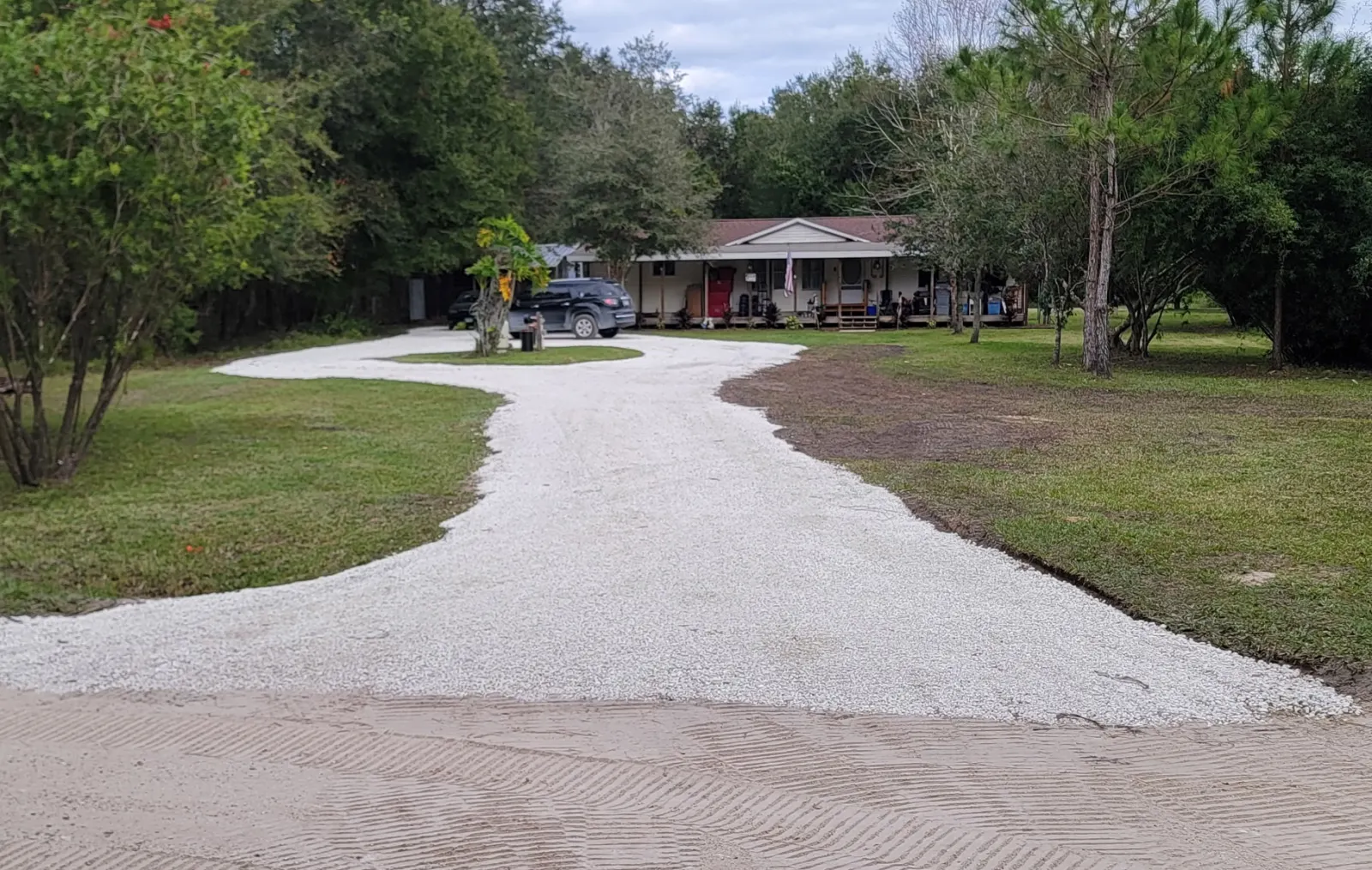
How Much Does a Gravel Driveway Cost in Florida?
National cost guides put an installed gravel driveway at about $1 to $4 a square foot. One guide lists $1 to $3. Another lists $1.25 to $4.00. A Florida cost site gives $1.50 to $4.00 a square foot, with $2.75 in the middle. On a drive 12 feet wide, that math comes to roughly $18 to $48 a running foot.
Long rural drives sit lower per foot. A national cost guide prices a residential road a tenth of a mile long at $10,600 to $15,260. That is about $20 to $29 a foot. A Florida cost site puts a full mile of gravel road at $25,000 to $85,000, with $40,000 in the middle. Spread over 5,280 feet, that lands closer to $5 to $16 a foot. These are market numbers, not our price list. We build gravel driveways and farm roads on rural property, and every drive gets a free estimate.
Why does the price per foot swing so much?
A short drive carries the same setup as a long one. Machines get hauled in and rock gets delivered either way. Those costs land on a small number of feet. A mile of road spreads the same setup across 5,280 feet, so the rate per foot drops.
Freight moves the number too. One national guide lists rock delivery at about $5 a mile. Another lists a flat delivery fee of $50 to $100. A Florida rock supplier sells from the plant and adds a $7.00 per load environmental fee. The farther the pit sits from your place, the more each ton costs on the ground.
| Line item | Published market range | Kind of source |
|---|---|---|
| Gravel driveway, installed | $1 to $4 per square foot | national cost guides |
| Gravel driveway in Florida | $1.50 to $4.00 per square foot | a Florida cost site |
| Residential road, a tenth of a mile | $10,600 to $15,260 | a national cost guide |
| Gravel road, one mile | $25,000 to $85,000 | a Florida cost site |
| State spec road base at the plant | $16.25 per ton | a Florida rock supplier price list |
| Crushed limestone | $30 to $40 per ton | national cost guides |
| Crusher run | $20 to $40 per ton | national cost guides |
| Clearing and grading the route | $1 to $2 per square foot | a national cost guide |
| Fabric or grid stabilization | $3 to $7 per square foot | a national cost guide |
| Regrading or resurfacing a gravel drive | $0.50 to $2.20 per square foot | national cost guides |
What are you paying for besides the rock?
A driveway is dirt work first. The route gets cleared, then topsoil and roots come off. The bed gets cut down to firm ground. National guides price land clearing at $1,270 to $3,900 on a typical job. One puts it at $200 to $6,000 an acre. Taking out a single tree runs $385 to $1,070, and a stump runs $200 to $700.
Shape is the part people skip. The federal gravel roads guide recommends about half an inch of crown per foot of width, near 4 percent. Rain then sheds to the sides instead of standing in the tracks. The same guide calls the roadside ditch the most important drainage feature on a rural road. A Florida cost site puts ditch work at $2,000 to $8,000 a mile.
That is the same excavation work we do on rural land. Where water has nowhere to go, cutting a drainage ditch belongs in the number.
Which rock belongs on a Florida driveway?
Florida road work runs on limerock. Section 911 of the state road spec is titled Limerock Material for Base and Stabilized Base Materials. It covers limerock, shell, shell rock and recycled concrete aggregate. That last one is why crushed concrete shows up as base rock here.
Price separates the layers. A Florida rock supplier priced its state spec road base at $16.25 a ton at the plant in January 2026. National guides put crushed limestone at $30 to $40 a ton and crusher run at $20 to $40. Washed number 57 stone runs $65 to $75 a ton in one guide.
Surface rock has to bind. The federal guide says a gravel surface needs fines and some plasticity to lock up. Clean washed stone has neither. That is why a pretty load of it often ends up in the ditch.
How deep does the rock go?
Depth drives tonnage, and tonnage drives the bill. National guides call 4 inches the minimum. Most put the working range at 8 to 12 inches. One describes 12 inches placed in three 4 inch lifts. A Florida cost page uses 4 inches compacted as its base case.
Traffic decides which end you land on. A drive that only sees pickups needs less rock than a road hauling loaded trucks and tractors. The federal guide is blunt about the order of work. A road built on a poor base or with bad drainage is a waste of money.
What pushes a rural driveway higher?
Wet ground is the big one. A Florida cost site says soft soils can move road costs up 2 to 3 times. One national guide prices fabric or grid stabilization at $3 to $7 a square foot. Geotextile fabric shows up at $200 to $2,500 a mile in another.
Length and access add up next. A drive through woods needs the route cleared and stumped before any base gets cut. That is the same work as clearing a building lot. A long run back to a barn means more rock, more passes and more truck travel.
Is rebuilding a rutted drive cheaper than a new one?
Usually, when the base under the ruts is still solid. National guides price regrading and resurfacing a gravel drive at $0.50 to $2.20 a square foot. Another lists gravel and dirt driveway repairs at $0.50 to $2.50 a square foot. A regrade to move standing water comes in around $3,000 in that same guide.
The catch is what sits under the ruts. Water standing in wheel tracks softens the base, and fresh rock on a soft base sinks. Cutting the crown back in and reopening the ditches comes first.
What about culverts and permits?
Some entrances need a culvert where the drive crosses a roadside ditch. Culvert work goes to the county or to another contractor. National guides price driveway crossings at $25 to $90 a foot, so it is worth asking early.
Permit rules change from county to county. National guides list permits and taxes anywhere from $50 to $2,000, and culvert permits from $50 to $500. Check with your county road department before a new connection gets cut.
How do you get a real number for your drive?
Every figure above is somebody else’s market data. Your price comes off your own ground. Length, width, the route, the ditches and how wet it gets all move it. A quarter mile of woods to open up prices nothing like a 60 foot pull to a carport.
Call or text (850) 815-0054 and we will come look at it. Estimates are free. Here is how we handle building and rebuilding gravel drives on rural land.