Forestry Mulching vs. Land Clearing: Which Does Your Florida Property Need?
Pick forestry mulching when you want the brush gone and the ground left covered. Pick land clearing when you need open dirt you can build on, dig in or drive on. Mulching grinds brush and small trees where they stand and leaves the chips on the ground. Clearing takes the wood, the stumps and the roots off the site.
For a North Florida landowner the split is simple. If the plan is trails, shooting lanes, understory, pasture edges or a view, mulching gets you there in one pass. If the plan is a homesite, a barn, a pond or a road, the stumps have to come out. That is a clearing job. The money splits the same way. National cost guides put mulching in the hundreds per acre and heavy clearing in the thousands.
What is the difference between forestry mulching and land clearing?
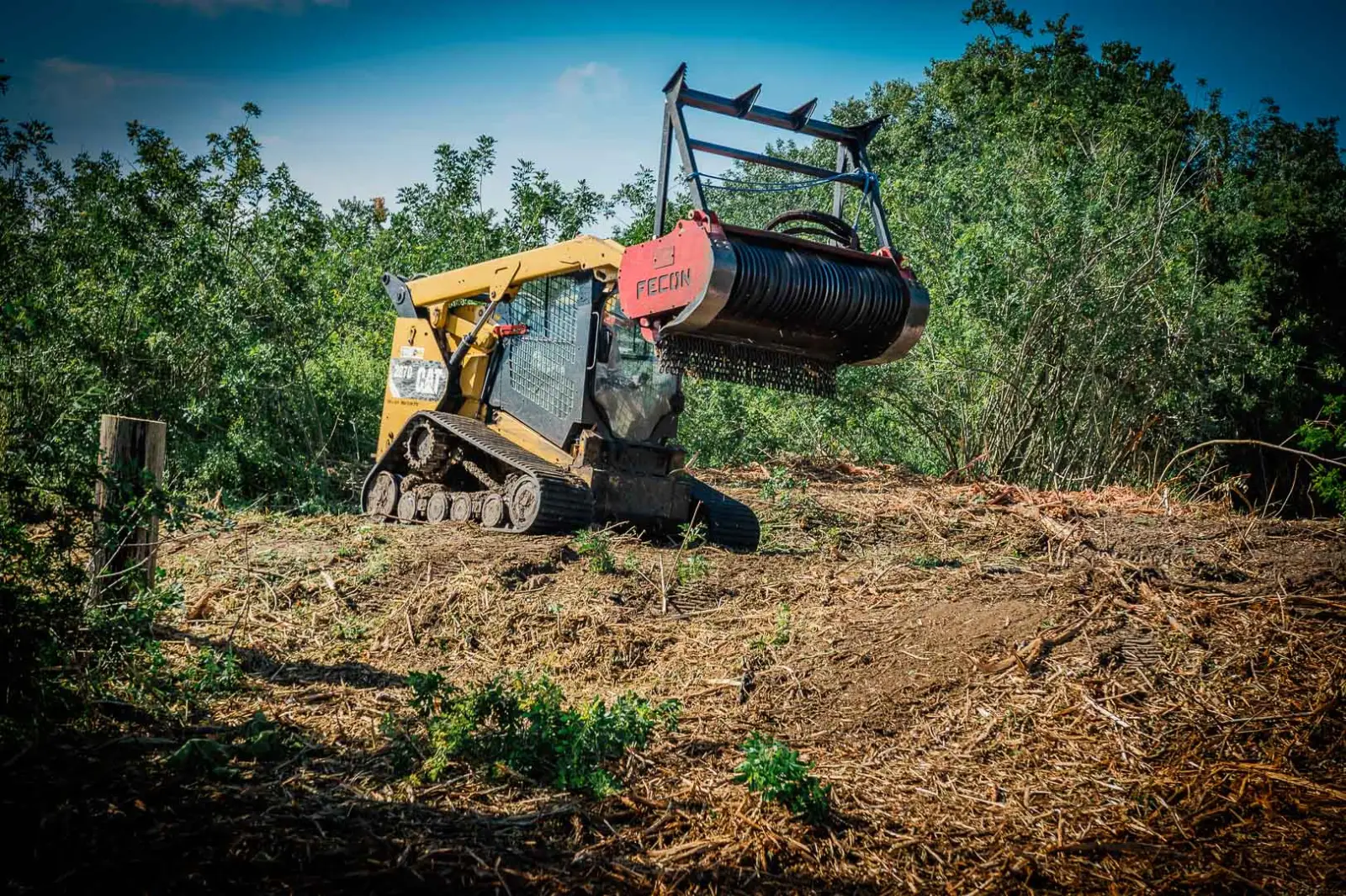
Forestry mulching runs a mulching head over standing vegetation. The head cuts the stem and grinds it into chips on the spot. The US Forest Service calls the method mastication. Its 2018 report RMRS-GTR-381 says excavators, skid steers and tractors can all carry these heads, front mounted or boom mounted. Forestry mulching is one machine working one pass at a time.
Land clearing is the wider job. The material gets cut, pushed and dug out, and the stumps and roots come up with it. Then the pile has to leave the property or be burned. Land clearing usually puts an excavator, a skid steer and a truck on the same tract.
What does each one leave on the ground?
Mulching leaves a layer of wood chips across the worked area. It also leaves the stumps. The Forest Service report notes that mastication heads leave either ragged or clean cut stumps, depending on the head. The root systems stay in the dirt.
Clearing leaves open soil. Stumps and root balls come out with the excavator. Ground like that can be graded, seeded, graveled or built on.
| Forestry mulching | Land clearing | |
|---|---|---|
| Ground after the job | Layer of wood chips | Open soil |
| Stumps and roots | Stay in place | Pulled out |
| Cut material | Stays on site as mulch | Burned or hauled off |
| Trees you want kept | Worked around easily | Harder to protect |
| Machines on site | One machine and a head | Excavator, skid steer, truck |
| Fits | Brush, understory, access | Building, digging, roads |
| Market cost per acre | Hundreds | Thousands when heavy |
Which jobs suit forestry mulching?
Mulching fits work where the goal is access and sight rather than dirt. Around Monticello that means palmetto and gallberry understory, grown-in pasture edges, old fence rows, trails, shooting lanes and view corridors. Thinning under planted pines is the same kind of work.
Stem size sets the limit. RMRS-GTR-381 lists vertical shaft heads treating trees about 6 to 8 inches across when boom mounted. Some horizontal shaft heads go larger. Past that size the passes slow down and a clearing plan starts to make more sense.
Which jobs need full land clearing?
Anything you plan to put in or on the ground needs the stumps out. A homesite, a barn site, a pond, a driveway or a farm road all start with a full clear. Chips and buried root balls are a problem under a building, a road base or a pond bank.
Digging brings one more step. Florida’s Sunshine 811 asks you to call 811 before you dig so member utilities can mark their lines. It is a free service and it applies to any dig, including stump work near a drive.
What works on wet ground and creek banks?
Wet ground changes the answer. RMRS-GTR-381 says wheeled carriers can rut wet soils. Boom mounted heads reach over difficult areas instead of driving to every tree. The report adds that a boom mounted machine can reach over wet areas and across draws.
That is the case for a mulching head on the excavator boom. The machine keeps its tracks on firm footing above and reaches down. Creek banks, ditch banks, pond edges and low wet corners get opened up from that footing.
Will the brush grow back after mulching?
Some of it will. Mulching cuts the top and leaves the root. UF/IFAS extension writes that mowing brush gives only short-term success because it leaves live stumps and root-stocks that re-sprout. UF/IFAS also notes that cutting a species like Chinese tallow can trade one stem for a stump with many.
The Forest Service report backs that up. One study summary in RMRS-GTR-381 found mastication alone gave an early increase in woody plants. Follow-up work was needed to hold the regrowth down. Plan on a second pass on brush ground, and treat the first job as the reset.
What happens to the debris, and what does Florida say about burning?
With mulching the debris is the mulch. It stays where it fell and breaks down over the seasons.
Clearing makes piles, and those piles get burned or hauled. Florida Statutes section 590.125 calls stacked land-clearing and tree-cutting debris a pile burn. Noncertified burning needs the landowner’s consent and an authorization from the Florida Forest Service before the fire is lit. The law also calls for firebreaks and enough people and equipment to hold the fire. The responsible person stays on site until it is out. Burning outside those rules is a second degree misdemeanor.
The other route is the truck. On our jobs the piles go on the truck. We handle hauling land debris off with a dump truck and dump trailer.
What do these jobs cost on the open market?
These are market numbers, not our price list. National cost guides put forestry mulching well below a standard clear.
| Work | Published market range |
|---|---|
| Forestry mulching, per acre | $400 to $600 (Bob Vila); about $450 average (Lawn Love) |
| Lightly wooded clearing, per acre | $500 to $2,000 (Bob Vila); $580 to $2,100 (Lawn Love) |
| Heavily wooded clearing, per acre | $3,000 to $5,600 (Bob Vila); $3,300 to $5,600 (Lawn Love) |
| Brush removal, per acre | $20 to $200 (Bob Vila); $330 to $630 (Lawn Love) |
| Stump removal, per stump | About $345 (Bob Vila); $130 to $350 (Lawn Love) |
| Debris hauling | About $135 per cubic yard (Thumbtack) |
| Florida land clearing average | $2,550 (Lawn Love) |
The gap between the two rows is the stumps and the debris. Mulching leaves both on the tract, so there is less handling and less trucking. Clearing pays for the dig and the hauling.
Which one fits your property?
Want the brush knocked down and the trees you like left standing? Start with what mulching covers and tell us the acreage. Building on it instead? Say so on the call and we will price the full clear. Free estimates, based in Monticello. Call or text (850) 815-0054.