
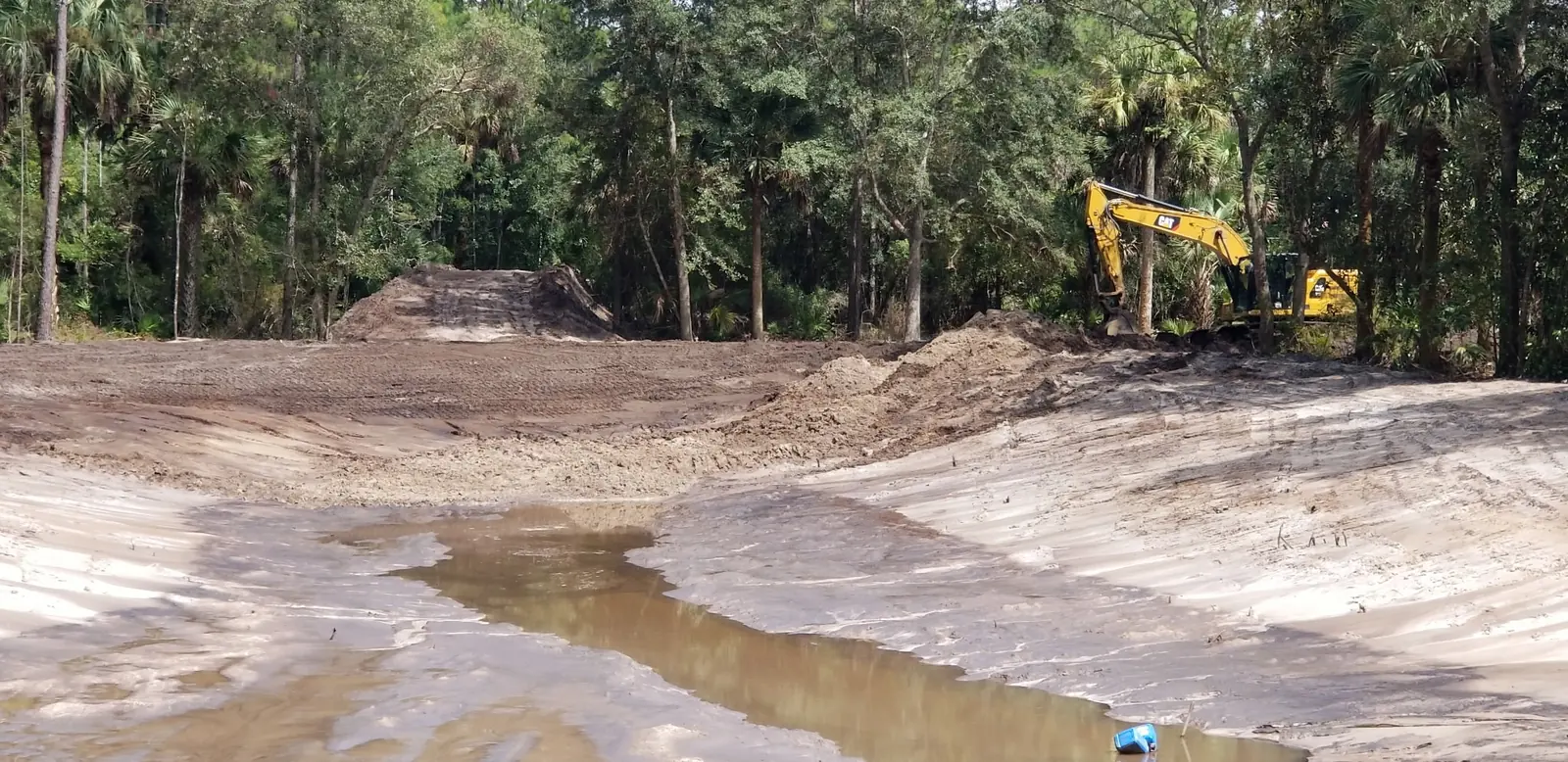
Do You Need a Permit to Dig a Pond in Florida?
Often not, if it is a farm pond dug entirely in dry upland ground. Florida Statute 373.406(13) exempts a wholly owned, manmade excavated farm pond built entirely in uplands from the state’s permit rules.
The exemption has limits. The work may not connect the pond to, or expand it into, wetlands or other surface waters. It does not cover a pond over 15 acres with an average depth over 15 feet. It also does not cover a pond less than 50 feet from any wetland.
Work in or near wetlands, creeks or other surface waters is another matter. So is building a dam or an impoundment. That work points to an Environmental Resource Permit, or ERP, from the state or your water management district. This is general information, not legal advice.
Is there a state permit to dig a pond in Florida?
The state permit that reaches pond work is the ERP. Part IV of Chapter 373, Florida Statutes, requires ERPs for many types of work within wetlands and surface waters. The Suwannee River Water Management District says an ERP is required for development or construction activities. It regulates agricultural and residential developments as well as commercial ones.
In Northwest Florida, the district and the Department of Environmental Protection, or DEP, run the ERP program jointly. Our pond construction work covers private land around Monticello. We plan each dig around the answer you get from the agencies.
What is the farm pond exemption and where does it stop?
The exemption covers building, altering, operating and maintaining a qualifying farm pond. For the meaning of farm pond, the statute points to section 403.927. There, a farm pond is a pond located on a farm, used for farm purposes, as district rule determines.
It stops at wetlands and other surface waters, and at any pond less than 50 feet from a wetland. Big, deep ponds fall outside it too: over 15 acres with an average depth over 15 feet. A pond dug for looks behind a new house may not meet the farm definition, so ask your district first.
What changes near wetlands, creeks and low ground?
The Suwannee River district says exempt activities cannot have wetland impacts. The Northwest Florida district’s list of wetland and surface water work needing an ERP includes dredging, filling and dams.
A low spot that stays wet may or may not count as a wetland under state rules. The Suwannee River district offers informal and formal wetland determinations, and only formal ones are binding. Ask for one before the machines go in.
ERPs also regulate the management and storage of surface waters. If the pond plan adds ditches or other drainage work, ask about that piece as well. Treat the table below as questions for the district.
| Situation | Likely path | Who to ask |
|---|---|---|
| Farm pond on a working farm, dug in dry upland, 50 feet or more from any wetland | Often outside the ERP rules under Statute 373.406(13) | Your water management district |
| Pond on a home lot, not a farm | The farm pond exemption may not fit; small projects with no wetland impacts may fall below state thresholds | Your district or DEP |
| Pond less than 50 feet from a wetland | The farm pond exemption does not apply | Your district |
| Digging into a wetland, creek or other surface water | ERP likely; federal Section 404 rules can apply | Your district or DEP, plus the Army Corps of Engineers |
| Building a dam or impoundment | On both districts’ lists of ERP work | Your district |
| Cleaning out or enlarging an upland farm pond | The exemption names alteration and maintenance, but not work into wetlands or other surface waters | Your district |
Which water management district covers your land?
The Northwest Florida district covers Leon, Wakulla and western Jefferson counties. The Suwannee River district covers all of Madison and Taylor counties and parts of Jefferson. So Jefferson County is split between the two. If your land is in Jefferson County, confirm which district covers your parcel first.
The Suwannee River district also publishes a guide to which state agency reviews a project. Land in the Aucilla River floodway is one of the cases it sorts.
Does the federal Clean Water Act apply?
It can. Section 404 of the Clean Water Act covers dredged or fill material placed in waters of the United States. Those include wetlands, and the work needs a permit unless it is exempt.
The EPA lists construction and maintenance of farm or stock ponds among exempt activities. That exemption covers work that is part of an established, ongoing farming or forestry operation.
Recapture takes the exemption away when two things are true. The work is a new use of the water. It would also reduce the reach or impair the flow of regulated waters, including wetlands. The EPA also says fill that converts a wetland to upland is not exempt.
The state and federal programs run separately. In Florida, the Army Corps of Engineers processes all 404 permit applications. Ask its local district office about your project.
What does the county require?
Jefferson County says a permit there takes two steps: a Development Permit from the Planning Department, then building permits. Its land development rules cover subdivisions, buildings of any type, driveways and power poles. Ponds are not named, so call Planning at (850) 342-0223 and ask.
In unincorporated Leon County, environmental management permits cover grading, among other work. The county’s page on those permits names no pond rule. Call its Development Support and Environmental Management department before you dig.
In Madison, Taylor or Wakulla County, call the county planning or zoning office. Inside city limits, ask the city as well. Our land clearing permit guide lays out the rules for clearing the pond site.
What else comes before digging?
Buried lines come first. Call 811 to reach Sunshine 811, a free service. It asks for two full business days before you want to start digging.
Gopher tortoises and their burrows are protected by state law. FWC treats any work within 25 feet of a burrow as a disturbance. It says you may not need a permit if all work stays at least 25 feet from burrows and tortoises. Our gopher tortoise permit guide covers the survey and the permits.
Then plan where the dirt goes. Spread it on dry ground, well away from any wetland. Spreading that spoil is part of our excavation work. It also moves the price, as our guide to what pond digging costs explains.
Can you get it in writing?
In the Suwannee River district, yes. Its staff can provide an exemption letter for a $100 permit fee. A No Permit Required letter, for small activities below the state thresholds, is also $100. Activities in both groups cannot have wetland impacts.
Meetings with district staff before you apply are free there. The Northwest Florida district also encourages meetings before you apply, and it helps determine the type of permit needed. Get the answer in writing before the first load of dirt moves.
Who digs the pond once the permit question is settled?
EM Land Services digs new ponds on private land around Monticello. We also enlarge and reshape old ponds and clean out silted ones. The permit decision belongs to you and the agencies. We are not a permit service, and nothing here is legal advice.
When you have your answer, see how our pond construction work runs. For a free estimate, call or text (850) 815-0054.