
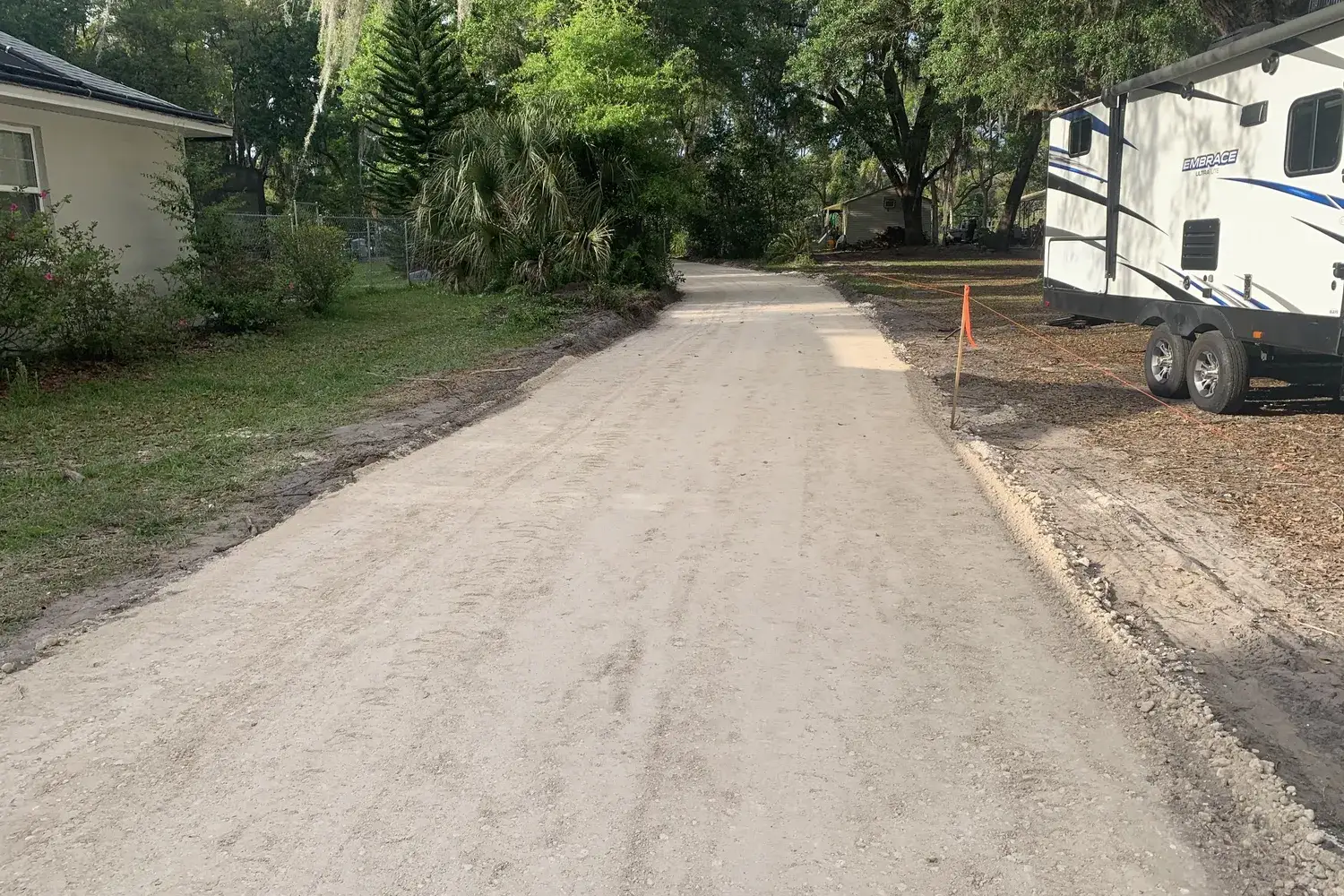
Crushed Concrete vs Limerock: Which Is Better for a Florida Driveway?
Both crushed concrete and limerock get used on drives around here, and either one can make a good driveway. Limerock is the rock Florida road work is built on. It packs into a hard, smooth surface, but its fines can turn slick and soft where water sits.
Crushed concrete packs firm too, and it often costs less when a recycling yard sits close by. The catch is what comes mixed in, since a load can hold bits of brick, asphalt, glass or wire. Our gravel driveways and farm roads start with the base and the ditches. Water ruins a drive faster than the wrong rock.
What is the difference between crushed concrete and limerock?
Limerock is mined rock. The state road spec, Section 911, describes it as limestone of marine origin. A limerock base is graded down to dust, and that fine material is what packs and binds.
Crushed concrete is old concrete broken back down to rock size. It comes from demolished roads, slabs, foundations and curbs. You will also see it called recycled concrete aggregate, or RCA. Section 911 lists it as a base material right beside limerock.
The state rates base rock with a strength test called the Limerock Bearing Ratio. In the 2015 edition of Section 911, limerock base has to average at least 100. Recycled concrete has to average at least 150. Those are floors for state spec road base, not a promise about every load from every yard.
How do crushed concrete and limerock compare side by side?
| Limerock | Crushed concrete | |
|---|---|---|
| What it is | Mined limestone | Old concrete, crushed and screened |
| State base spec | Section 911, bearing ratio average of 100 or more | Section 911, bearing ratio average of 150 or more |
| How it packs | Fines pack into a hard, smooth crust | Dense grades with fines pack firm |
| When it stays wet | Fines can go slick and soft where water stands | Screened grades with fewer fines let water through |
| Dust in a dry spell | Fines make dust | Mortar fines make dust too |
| What rides along | Spec caps water sensitive clay at 3 percent | Possible brick, asphalt, glass or wire |
| What drives the price | Plant price plus freight | Often cheaper near a recycling yard |
Neither one stays perfect without care. Ruts show up wherever water stands, and the fix is shape before more rock.
Which holds up better on sandy ground and on clay?
North Florida has both kinds of ground. Loose sand will not carry a load by itself. Rock with plenty of fines, like limerock or dense crushed concrete, packs into a crust over the sand. Clean, round or washed stone tends to roll out and scatter.
Red Hills clay is the opposite problem. Clay holds water, goes soft, and works up into the rock under traffic. A national cost guide notes that separation fabric can keep soft soil from moving into the stone. Even so, drainage decides a clay drive more than the rock does.
Washouts start where water runs down the drive instead of off it. Both rocks lose their fines from a rut that holds water, and the rut grows from there. A crowned road and open drainage ditches keep water out of the base.
Where the drive meets a county road, our driveway permit guide covers the connection. We do not install culverts, and the county sets what a road connection needs.
What gets mixed into crushed concrete?
Recycled rock is only as clean as the concrete that went into the crusher. A national guide says a load may hold small asphalt pieces, brick fragments or bits of reinforcing wire.
The 2015 state spec sets limits for recycled road base. Bricks, asphalt, and glass or ceramics are capped at 1 percent by weight each. Rebar and wire mesh, wood, and plaster are capped at 0.1 percent, and the material must be asbestos free.
A pile at a yard may not meet that spec. The same guide suggests asking whether it is clean concrete, mixed construction aggregate, or a blend with asphalt and masonry. A stray piece of wire can flatten a truck tire, so look at the pile before it ships.
Fresh crushed concrete also carries leftover cement paste. That guide says it can make alkaline runoff, and placement near wetlands, streams or wells may call for added review. If the drive runs past a pond or a well, check with your county before the rock goes down.
Is crushed concrete cheaper than limerock?
Often, near a recycling yard. A national cost guide says crushed concrete is often cheaper than quarried limestone or granite. The same guide says that edge shrinks when the recycled source sits far from the job. Plant prices for road base leave freight off, so distance to your place gets added on top.
| Material | Published market price | Kind of source |
|---|---|---|
| Crushed concrete, picked up at a recycling yard | $9 to $25 a ton | a national cost guide |
| Screened, washed or tightly graded crushed concrete | $20 to $50 a ton | a national cost guide |
| Crushed concrete by volume | $11 to $35 a cubic yard | a national cost guide |
| Local delivery of a load | $100 to $300 or more | a national cost guide |
| State spec road base at the plant | $16.25 a ton | a Florida lime and stone company, January 2026 |
| Environmental fee on that company’s loads | $7.00 a load | the same price list |
| Driveway gravel in general | $30 to $100 a ton | a national cost guide |
These are market numbers, not our price list. Tons and yards do not trade evenly, and one guide puts a loose yard at roughly 1.2 to 1.4 tons. Ask each supplier for its own figure before you compare quotes. For what a whole drive costs, see our gravel driveway cost guide.
What about granite, crushed limestone or crusher run?
Quarried stone is the third option. A national guide says virgin crushed stone gives more consistent color, hardness and gradation. Crusher run, which is crushed stone with its fines left in, packs much like a base rock. Per ton prices for crushed limestone and crusher run sit in the cost guide linked above.
Round rock is a different story. Pea gravel and river rock do not compact and interlock the way crushed rock does. On a working drive, they roll under tires and drift into the ditch.
Which rock should go on your drive?
Both get used on drives around here, and the right pick comes from the ground. A drive on high, sandy ground needs something different from one crossing a wet clay bottom. A drive for pickups is built lighter than a farm road hauling loaded trucks. On a new homesite, the drive usually follows clearing the building lot.
We look at the route, where water crosses it, and what runs over it. The rock gets settled with you at the free estimate. Call or text (850) 815-0054, and see how we build a gravel driveway or farm road on rural land.