
Do You Need a Driveway Permit in Florida?
Usually, yes, if the new drive meets a public road. In Florida, the driveway permit is about that connection, where your drive meets the road. Who issues it depends on who maintains that road.
On a county-maintained road in Jefferson County, you need the county’s Road and Driveway Connection Permit. The county’s 2025 application lists a $53.00 fee. The Road Department decides whether a culvert is needed and inspects it after installation. The county permit is not required when you connect to a private road.
A drive onto a state highway goes to FDOT under Rule Chapter 14-96. Roads inside Monticello city limits are maintained by the City of Monticello, so ask the city there. This guide is general information, not legal advice.
Who issues a driveway permit in Florida?
The permit comes from whoever maintains the road out front. Jefferson County’s road page lists US 19, US 90 and I-10 as FDOT roads.
| Where your drive meets the road | Who handles the permit | What they look at |
|---|---|---|
| A county-maintained road in Jefferson County | Jefferson County Road Department | Whether a culvert is needed, then an inspection |
| A state highway such as US 19 or US 90 | FDOT, under Rule Chapter 14-96 | The Driveway/Connection Application for All Categories |
| A street inside Monticello city limits | City of Monticello | Ask the city what it requires |
| A private road in Jefferson County | No county connection permit | County land development rules still cover driveways |
| A Leon County road | Leon County Development Support and Environmental Management | Work in the county right of way, including the culvert |
| A Madison County road | Madison County Public Works/Road Department | An inspection sets each turnoff’s specs |
| A Taylor, Wakulla, Thomas, Grady or Brooks County road | That county’s road department | Call before any work starts |
Our gravel driveways and farm roads go in after this question is settled. The permit itself is between you and that office.
What does Jefferson County ask for?
The county’s application says all new road and driveway connections to a county-maintained road need the permit. It names driveways more than one year in age as well, so ask before reworking an older entrance. Here is what the application asks for:
- A 911 address. If no numbered address exists for the land yet, submit a 911 Address Form first.
- Proof of ownership. Attach a recorded copy of the warranty deed, or an agent authorization form if you are not the owner.
- The fee. The permit fee is $53.00, with checks made out to the Board of County Commissioners.
- White flagging. Stake the middle of the proposed driveway with white flagging.
- The culvert decision. The Road Department determines whether a culvert is required at the connection.
- The inspection. After installation, the Road Department inspects the culvert. Call 850-997-2036 to request it.
Why does a driveway culvert come up?
The ditch along a county road carries water off the road. A drive across that ditch can dam it without a pipe under it. Jefferson County decides on a culvert, or an update to an old one, so the county road keeps draining.
On Leon County’s form, the culvert sits at the ditch bottom and is at least 18 inches across. Its size must match the culvert uphill to keep the existing flow. Where no culvert is required, the ditch has to keep its contour.
On these county roads, the culvert is the county’s call, and the county inspects it. Ask the road department what it needs before any work starts at the road.
Do you need a permit for a farm road on your own land?
Jefferson County’s connection permit is not required when connecting to a private road. A farm road that stays inside your property is a separate question from the county road. The county’s land development regulations apply to all development, and its list names driveways. Call the Planning Department at (850) 342-0223 before a new road goes in.
Low ground and tortoise burrows can matter too. State law requires environmental resource permits for many types of work in wetlands and surface waters. FWC treats any work within 25 feet of a gopher tortoise burrow as a disturbance. It says you may not need a permit if all work stays at least 25 feet from burrows and tortoises.
Our land clearing permit guide covers the wetland and tortoise rules. A drive to a new homesite often follows lot clearing. Where water crosses the route, our drainage work gives it a path off the road.
Do you need an FDOT driveway permit for a state highway?
A connection to a state highway goes to FDOT, not the county. FDOT’s permits run under Rule Chapter 14-96, State Highway System Connection Permits. Its application is the Driveway/Connection Application for All Categories.
FDOT’s access management page links a list of driveway permit contacts for each county. The list sits on FDOT’s One-Stop Permitting site. Not sure if your road is a state highway? Ask that contact or the county road department.
What about Leon, Madison, Taylor, Wakulla and Georgia?
In Leon County, Development Support and Environmental Management takes driveway connection applications for county roads. Its residential form, revised in 2023, lists a $185.00 fee. That permit covers work in the county right of way only. Canopy road connections need more permitting, so call 850-606-1300 first.
In Madison County, requests for driveway turnoffs go to the Public Works/Road Department at (850) 973-2156. The Road Department Coordinator or a designee inspects each location to set the specs. Work by private citizens on county road right of way must be permitted by the Road Department Coordinator first.
For Taylor or Wakulla County, call that county’s road department before work starts. Do the same in Thomas, Grady or Brooks County, Georgia. We travel across the state line from Monticello for that work. Inside any city’s limits, ask the city too.
What should you have ready before the machines come?
Settle the paperwork first. Have these in hand before the machines show up:
- The permit, or word from the county or FDOT that none is needed.
- A 911 address, if your county asked for one.
- The culvert decision, if the drive crosses a roadside ditch.
- A Sunshine 811 call (dial 811), two full business days before you want to start digging.
- Your property lines and the route you want the drive to follow.
Cutting a roadbed is digging, so the 811 call comes first. Cost is the other planning question. Our guide to what a gravel driveway costs in Florida covers what moves the price.
Who builds the driveway once the permit is settled?
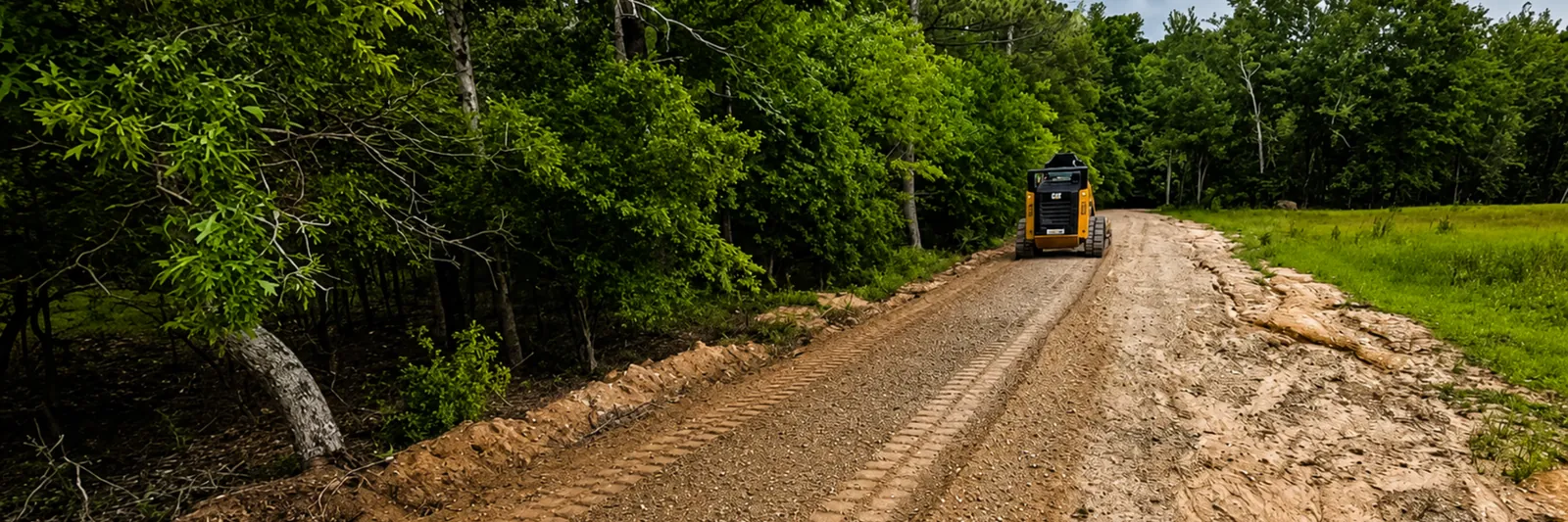
EM Land Services builds gravel driveways and farm roads on rural land around Monticello. We clear the route, cut the base down to firm ground and shape a crown so rain runs off. Rock comes in on our dump truck and dump trailer.
The permit is between you and the county or FDOT. Once it is settled, see how our gravel driveway work runs. For a free estimate, call or text (850) 815-0054.